
Friable vs Non-Friable Asbestos: What’s the Difference and Why Does It Matter?
If you’ve received an asbestos inspection report, you may have seen the words friable and non-friable used to describe what was found.
These aren’t just technical terms. They determine who can legally remove the asbestos, what controls are required, what the job will cost, and how urgently the work needs to happen.
With asbestos, you get one shot at getting it right. Understanding what you’re dealing with before anyone starts work is not overcaution. It’s the basic requirement for doing the job safely.
What Is Non-Friable Asbestos?
Also called bonded asbestos, its fibres are typically mixed directly into cement. Once set, this holds the hazardous material in place, so it doesn’t release dust under normal conditions.
Provided it remains intact and isn’t being cut, drilled, sanded or disturbed, non-friable asbestos poses a lower immediate risk. It can often be managed in place rather than removed straight away.
This is the most common type found in Sydney homes. Properties built between 1940 and 1987, particularly across the fibro belt suburbs of Western Sydney, frequently contain bonded asbestos in multiple locations.
Common Non-Friable Materials:
- External wall cladding, such as fibro sheeting and weatherboards.
- Asbestos cement eaves, soffits, fascias, and gutters.
- Corrugated asbestos roofing, including Super Six sheeting on garages, sheds, and industrial buildings.
- Vinyl floor tiles in kitchens, bathrooms, and laundries.
- Internal wall and ceiling linings, flat asbestos cement sheeting in bathrooms, laundries and kitchens.
- Asbestos cement fencing.
What Triggers Removal?
You’ll need to remove non-friable asbestos when it’s damaged, deteriorating, or in an area about to be renovated or demolished. It’s also necessary when a property inspection flags it, or when a management plan recommends removal based on current condition.
What Is Friable Asbestos and Why Is It More Dangerous?
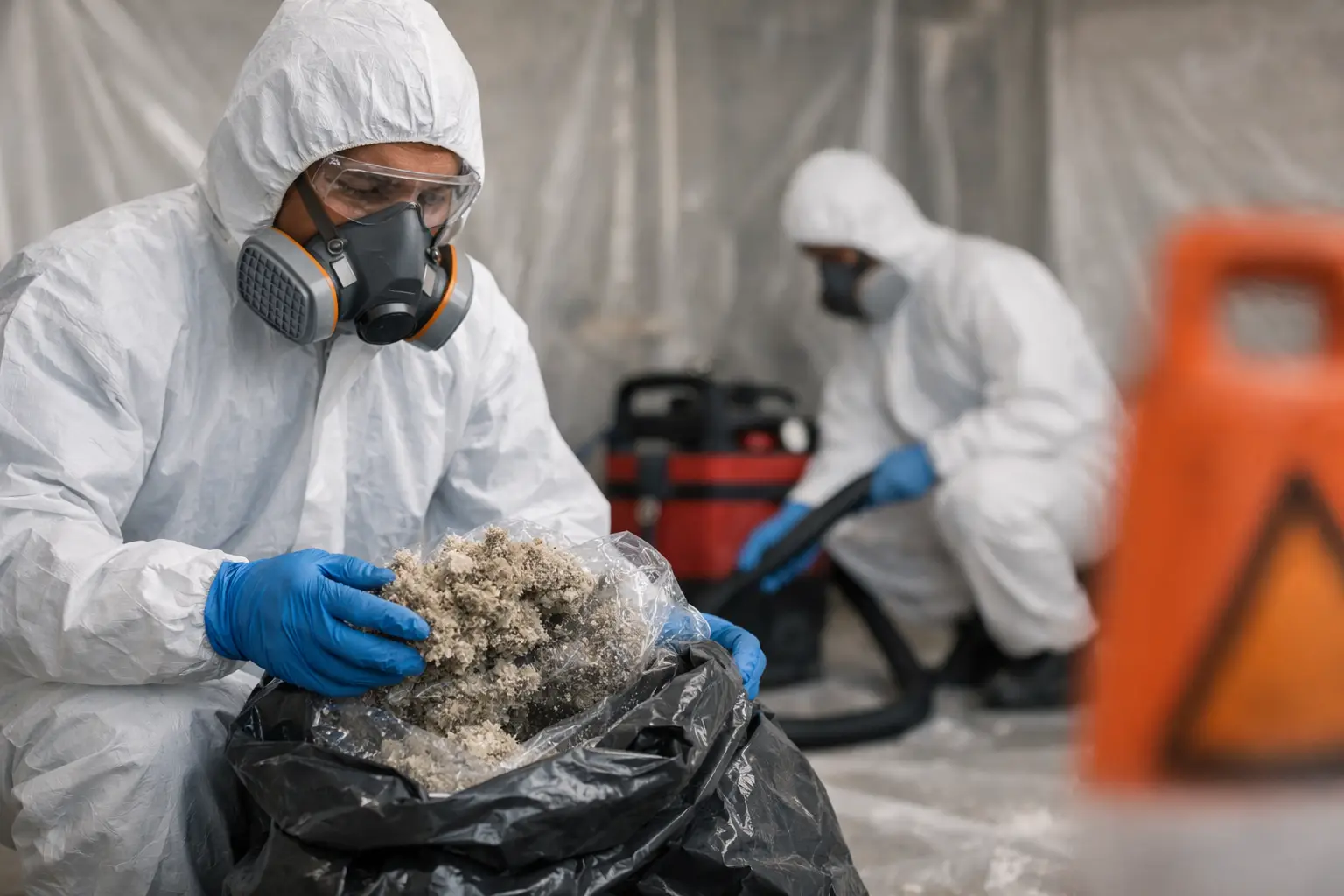
In short, any asbestos-containing material that breaks up, crumbles, or can be crushed under hand pressure is friable.
The most significant difference between the two types is fragility. Unlike bonded asbestos (which, if you remember, is set firmly in material like hard cement), friable has nothing holding it together.
However, the risk isn’t just that the material contains asbestos. It’s that fibres release with minimal provocation. Air movement, vibration, and light contact can all cause the material to disintegrate, releasing asbestos fibres into the air.
That extreme instability is why friable asbestos carries high health risks and strict removal rules. Once airborne, these invisible fibres remain suspended in the air for hours. Inhaling them is the primary cause of diseases like mesothelioma and asbestosis, and increases the risk of lung cancer, typically taking 20 to 40 years to develop.
Bonded Asbestos Can Also Become Friable
A material can cross from non-friable to friable through disturbance or age. For example, someone pressure washing an asbestos roof sends fibres straight into the air, even though that roof was classified as non-friable in its original state.
Fire damage, storm damage, and prolonged weathering all carry the same risk. Once whatever is holding it together breaks down, the material is friable regardless of how it was originally classified.
Common Friable Materials Found on Sydney Sites:
- Pipe lagging wrapped around hot water systems, boilers, steam pipes, and industrial plant. The lagging sits inside a hessian wrap. Once the hessian is removed, the asbestos insulation beneath is immediately friable.
- Spray-on fireproofing and acoustic insulation applied to structural steel in commercial buildings, stairwells, and carparks built before 1990.
- Loose-fill ceiling insulation, including Mr Fluffy material installed in NSW homes during the 1960s and 1970s.
- Vinyl floor tile paper backing. The adhesive mastic beneath tiles is also friable. Even though the mastic is bonded in its solid state, the act of scraping it off disintegrates it during removal. The removal process itself makes it friable.
- Insulation bats cross-contaminated during poor asbestos roof removal. When a roof is removed without proper controls, fragments fall onto the ceiling insulation below.
- Asbestos buried under houses or in garden beds, where material has been illegally dumped to avoid disposal costs.
- Old oven mitts, welding suits, gaskets, and brake pads from the asbestos era. These are still found in drawers and cupboards in older properties. They’re all friable.
The Legal Difference in NSW
Under the Work Health and Safety Regulation 2017 (NSW) and the SafeWork NSW Code of Practice: How to Safely Remove Asbestos, the two material types require different licences.
Non-Friable Asbestos Removal
If you’re removing more than 10 square metres of non-friable asbestos, NSW law says you must hire a licensed contractor (Class B or Class A). This threshold applies to the total quantity across the site, not a single sheet or section.
Below 10 square metres, unlicensed removal is allowed. However, regulations strongly recommend using an authorised person to carry out the work. And, strict safety and disposal rules still apply.
Friable Asbestos Removal
When you’re dealing with friable asbestos, any amount must be removed by a Class A licensed contractor. There is no minimum threshold. Even a tiny fragment of crumbling material must be handled under Class A conditions.
It also carries additional requirements:
- A certified safety management system.
- A licensed supervisor physically present on site at all times.
- Full containment and enclosure.
- Independent air monitoring.
- Certificate of Reoccupation before the area can be re-entered.
Class A contractors can carry out all Class B work, but a Class B contractor cannot legally touch friable asbestos under any circumstances.
Why Hiring a Class A Removalist From the Start Prevents Project Delays
Given how common non-friable asbestos is in NSW, Class B licensed contractors carry out essential work. However, older properties can hold hidden surprises. What originally looked like a Class B job could turn out to be friable material once renovation or demolition begins.
The Problem With Change in Scope During Your Project
If your Class B removalist encounters, for example, deteriorated pipe lagging or damaged ceiling material, or any other type of asbestos-related material that’s degraded from its original state, legally, they cannot touch it. They aren’t equipped nor trained for removal of friable asbestos.
When unexpected friable material is found on your site, work must stop straight away. And, because your Class B contractor can’t continue, your project can’t continue either, which means:
- Forced work stoppages – your site must be isolated while you find a Class A licensed specialist.
- Tradie delays – all contractors must remain off-site, delaying your project schedule.
- Additional costs – the knock-on effect of the above in both time, money and hassle.
Don’t Be Tempted to Keep Work Moving
If a Class B contractor removes friable asbestos on your property, even unknowingly, the work is unlicensed. As the owner of the property, or the PCBU (Person Conducting a Business or Undertaking), under NSW law, you’re legally responsible alongside the contractor to ensure the correct licence is being used.
Hiring the wrong licensed contractor for the work could lead to serious liability consequences, including court proceedings.
One Point of Contact From the Start
Choosing a Class A licensed removalist from the beginning acts as a safety belt for your project’s timeline. Because they can legally carry out both friable and non-friable work, if anything unexpected is discovered behind a wall or in the flooring, you’re covered for all scenarios.
Your Class A team will adjust their controls and keep working. Your project will continue safely, legally and with minimal disruption.
What To Check Before You Hire
Before engaging anyone, complete these three basic steps to protect your schedule:
- Ask for their licence class – verify whether they hold Class A or Class B status on the SafeWork NSW public register.
- Confirm public liability insurance – check their policy specifically covers specialist asbestos removal work.
- Book an initial site assessment – have an experienced professional inspect the space to identify potential friable risks before trades begin work.
Not Sure What Type of Asbestos You’re Dealing With?
Confirming Friable vs Non-Friable Asbestos
The only safe and reliable way to establish whether a material is friable or non-friable is through professional asbestos testing carried out by a licensed assessor combined with laboratory analysis where required.
Do not attempt to test materials yourself by pressing or breaking them. If a material is friable, handling it releases fibres.
If you’re in any doubt, treat the material as friable until a licensed assessor confirms otherwise.
Management vs Removal: What To Consider
Sealing & Ongoing Control (Non-Friable)
When stable and in good condition, non-friable asbestos removal isn’t the only option; it can be sealed (encapsulated). This involves using a specialist coating or barrier to trap the fibres, preventing them from becoming airborne.
Managing asbestos this way can save you money, but it does rely on strict site controls. One minor miscommunication, and you could switch from a ‘safe’ wall to a hazard. For example, an electrician running new cables who unexpectedly needed to drill a hole, or an emergency plumber who came to fix that leak.
Leaving asbestos in place requires continual discipline:
- A formal asbestos management plan and a current register.
- Strict protocols for every person who enters the building or works on the site.
- Everyone needs to read the report, understand it, sign it, and confirm they know where the asbestos is. All before they arrive.
A written plan doesn’t protect anyone if nobody enforces it.
Mandatory Removal (Friable)
Management is not the answer: you cannot do this safely. Friable asbestos should be removed as soon as reasonably practicable. It’s a safety standard requirement.
Friable and Non-Friable Removal: What the Process Involves
Non-Friable Removal:
- Written scope and fixed quote confirmed before work begins.
- Site set-up with appropriate barriers and signage.
- Wet-down of materials before and during removal to suppress dust.
- PPE throughout – respirator, disposable coveralls, gloves.
- Materials removed intact where possible, double-bagged and labelled.
- HEPA (high-efficiency particulate air) vacuum used for residual dust.
- Waste transported to an EPA-licensed facility with waste consignment certificate.
- Visual clearance inspection on completion.
Friable Removal (Additional Controls Required):
- Asbestos Removal Control Plan prepared and shared before work begins.
- Full containment and enclosure of the work area.
- Negative air pressure units running throughout removal.
- Licensed supervisor physically present on site at all times.
- Air monitoring before, during, and after removal by an independent licensed assessor.
- Decontamination unit for workers exiting the enclosure.
- Chain of custody – all waste double-bagged, labelled, and transported.
- Certificate of Reoccupation issued before the area can be re-entered.
Protection, Compliance & Complete Documentation: The J Group Industries Standard
Air Monitoring & Baseline Confirmation
J Group Industries sets up air monitors before work begins, collecting a minimum of 400 litres of air in cassettes labelled as pre-works. Monitoring continues during and after removal.
This creates a before, during, and after record. If pre-work samples show fibres already in the air, that baseline is established. If post-work samples show zero fibres, you have documented verification of air quality.
What You Receive After Removal
Every J Group Industries asbestos removal includes complete documentation:
- Written scope of work and fixed quote.
- Asbestos Removal Control Plan.
- Risk assessments.
- Waste consignment certificates.
- Air monitoring results.
- Clearance inspection report.
- Certificate of Reoccupation.
These documents satisfy SafeWork NSW requirements and are suitable for WHS audits, insurance claims, property transactions, and ISO compliance records. You get the complete verification you need to keep your project moving.
Call J Group Industries To Request a Written Scope and Fixed Quote
Friable vs Non-Friable FAQs
What’s the Difference Between Friable and Non-Friable Asbestos?
Non-friable (bonded) asbestos has fibres locked in a solid material such as cement or vinyl. When intact, it holds these fibres within the material, preventing their release into the air.
Friable asbestos can be crushed by hand pressure. It releases fibres easily and carries a significantly higher health risk.
Can Non-Friable Asbestos Become Friable?
Yes. Bonded asbestos that’s been damaged, pressure washed, fire-damaged, or heavily weathered can degrade and become friable. The original classification doesn’t remain fixed. Its current physical condition is what determines how it must be handled.
Is the Paper Backing Under Vinyl Floor Tiles Friable?
Yes, it is. The paper backing disintegrates during removal and is legally treated as friable. The adhesive mastic beneath the tiles is also friable because scraping it off breaks it down. Both require appropriate controls.
Do I Need a Class A Licence for Fibro Sheeting?
It depends. In most cases, fibro sheeting is non-friable and falls under Class B. However, if its condition has deteriorated, become compromised, or degraded, it may be assessed as friable and require Class A. Only a licensed assessor can confirm which applies.
What Happens if a Class B Contractor Encounters Friable Asbestos Mid-Job?
Work must stop straight away. They aren’t legally permitted to handle friable asbestos. Keep in mind that as the person who commissioned the work, you remain legally responsible for what occurs on your site.
How Do I Know if My Property Has Friable Asbestos?
The most common friable materials in Sydney properties are pipe lagging, spray-on insulation, vinyl floor tile backing, and deteriorated bonded materials. A physical inspection by a licensed assessor is the only reliable way to confirm what is present and in what condition. Properties built before 1980 carry a higher likelihood.